Every major property management platform now ships a website with the subscription. AppFolio has AppFolio Sites, Buildium includes a free hosted site, DoorLoop has a built-in builder, and most of the smaller platforms bundle something comparable. It is included, it publishes your vacancies with one click, and it takes applications straight into the software. For plenty of companies that is genuinely enough. For the ones trying to win owner accounts, it quietly stops being enough, and the reason has very little to do with how it looks.

What the included website actually gives you
Start with what is really in the box, because the marketing pages and the reality are closer than most agencies admit. Buildium describes its offering plainly as a free property management website hosted by Buildium, says you can point your own domain name at it, publishes a unit to the site when you click List, and hosts your customized rental application so a prospect can apply on your own site rather than being bounced somewhere else. That is a working leasing funnel, included, with no separate invoice.
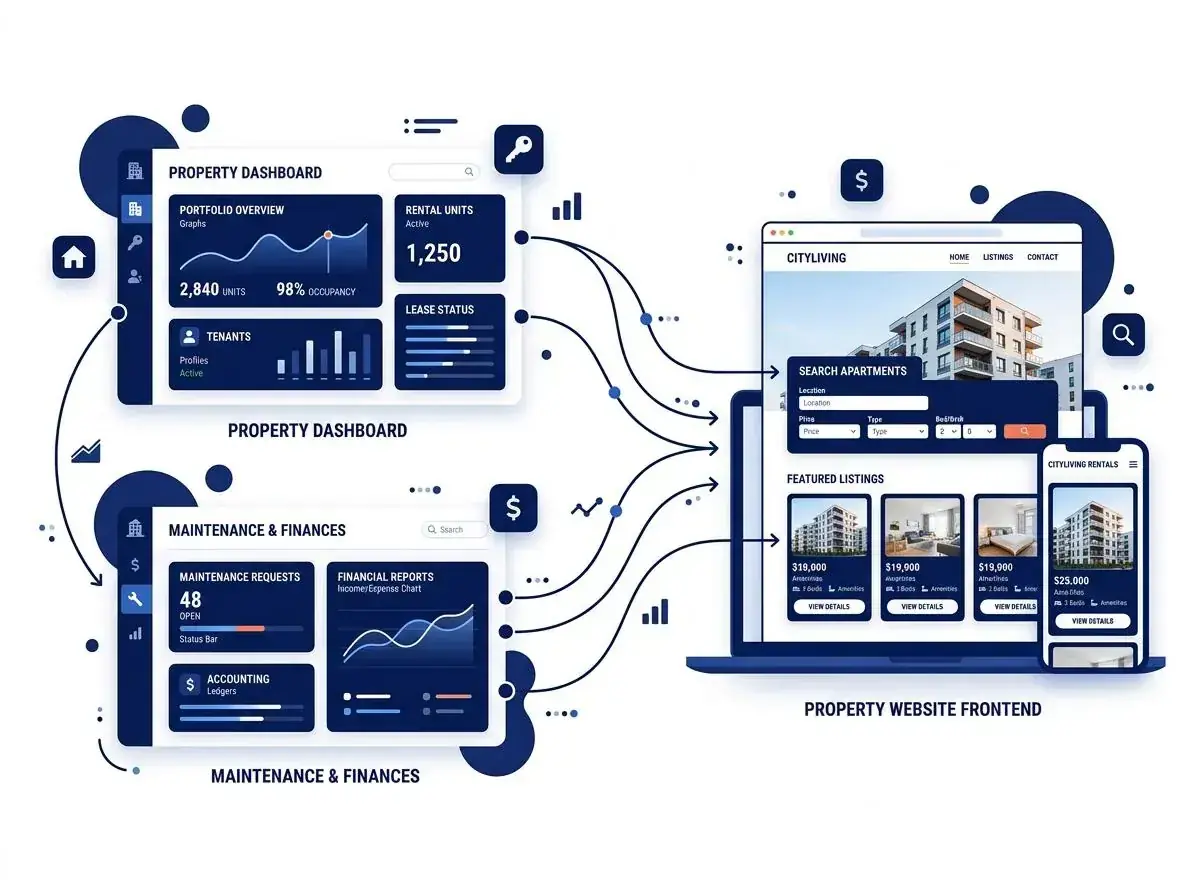
AppFolio's version, renamed from AppFolio Professional Websites to AppFolio Sites, goes further. It is fully integrated with AppFolio Property Manager, so vacancies, online rent and maintenance requests all run through the same system. It ships an expanded template library, domain hosting, reporting dashboards, and content support from AppFolio's own website team, who handle SEO around common industry terms and your geography. Every AppFolio Site includes the AudioEye accessibility platform, which matters in a category where fair housing and accessibility complaints are a live risk. You can also spin up an individual site for each property in the portfolio. DoorLoop offers the same shape of thing: a built-in builder, a set of templates, a custom domain, listings and applications on the site.
None of that is a token feature. If your problem is that vacancies need to be online, applications need to land in your software, and residents need somewhere to log in, the included site solves your problem on day one for no additional cost. The honest answer for a young company under a few hundred units is usually to take it and spend the money on leasing instead.
Why the decision matters more than it used to
Buildium's 2026 Property Management Industry Report, drawn from a survey of more than 3,200 property managers, rental owners and renters, describes an industry with big growth ambitions and thin margins to fund them. 75 percent of companies plan to expand their portfolios in the coming year, but only 55 percent actually grew over the past one. That 20 point gap is the whole story. Meanwhile 93 percent saw expenses rise, and half named adopting new tools or getting more out of existing ones as their main way of controlling cost.
The gap between planning to grow and growing
75%
of property management companies plan to expand their portfolios this year
55%
actually grew their portfolio over the past year
93%
saw operating expenses increase over the same period
Source: Buildium 2026 Property Management Industry Report, based on a survey of more than 3,200 property managers, rental owners and renters.
Growth in this business means owner accounts, not more renters. The same report is specific about what owners are actually buying. 74 percent rate the customer service experience above every other factor when choosing a manager. 61 percent are looking for expert help managing, attracting and retaining residents. 33 percent now cite compliance with rental regulations as a reason to hire out, up from 21 percent in 2021. Those are not questions a vacancy list answers.
The included site is built for renters, not owners
This is the structural point, and it is not a criticism of the software vendors. Their website product exists to move a unit from your rent roll to a public listing and back again with an application attached. It is engineered around that loop, and it does it well. An owner deciding whether to hand you a 400,000 dollar asset is running a completely different evaluation. They want to know what you charge, how you screen, how fast you fill, what happens when a resident stops paying, and whether you understand the specific ordinance in their city. That content does not exist in a listings template, and there is usually nowhere natural to put it.
| What you need it to do | Website included with your software | Standalone site you own |
|---|---|---|
| Publish vacancies and take applications | Native, real time, no integration work. This is what it was built for | Works through an API, feed or embed. Good, but somebody has to build and maintain it |
| Win owner accounts | A services page and a contact form inside a template designed around listings | Dedicated owner journey, pricing, proof, market pages and its own calls to action |
| Rank for the searches owners run | Vendor-managed SEO on generic industry and geographic terms | Unlimited pages, city pages and articles targeting the exact queries you want |
| Look different from your competitors | A template library shared with every other company on the same platform | Whatever you design, constrained only by budget |
| Control page speed and code | Whatever the vendor ships. You cannot fix what you cannot edit | Fully in your hands, including images, scripts and Core Web Vitals work |
| Survive a change of software | The site is part of the subscription. Leave the platform and you rebuild | Swap the listings integration and keep the site, the content and the rankings |
| Cost | Included, or a small add-on on top of your per unit fee | A real project cost up front, then hosting and maintenance |
Three places the bundled site runs out of room
The first is the content ceiling. Owner acquisition through search is a volume game played with pages: one for each city or county you serve, one for each service tier, one for each question an owner types at eleven at night when a resident has stopped paying. Most bundled builders are point and click editors over a fixed page set. You can change the words. You cannot always add the forty pages that would make you the obvious local answer, and you usually cannot control titles, headings and internal linking closely enough for those pages to compete.
The second is the sameness. A template library is a finite set, and every company on that platform is drawing from it. An owner comparing three managers in your market can end up looking at three sites with the same layout, the same stock photography and the same section order. When the product is trust, looking interchangeable with your competitors is an active liability, and it is the one problem no amount of editing inside the template will fix.
The third is portability, and it is the one that gets people. Your website is tied to your software subscription. Property managers change platforms more often than they expect, usually because they outgrow the accounting or the trust setup. When that day arrives, the website goes with it. Every page, every ranking and every backlink you built over four years belongs to a product you are leaving. Rebuilding a site is survivable. Rebuilding the search visibility underneath it takes far longer.
The domain question is the one that compounds
Whatever you choose, get your own domain onto it. Every major platform supports this, and every platform also has a default address on its own domain that works fine on day one and costs you quietly forever. Search engines treat a subdomain as a separate property. Authority and links do not automatically flow between it and anything else you publish, which means the reputation you build there is being built on rented ground, under somebody else's name.
The same logic applies to where your content lives. Keeping the blog, the city pages and the owner resources on one domain concentrates every link and every signal in one place. Splitting them across a vendor subdomain and a marketing site means running two SEO programs and getting the compounding benefit of neither. Analytics suffers too, because the two hostnames report as separate traffic sources unless somebody configures cross domain tracking properly, and in most companies nobody does.
Seven steps to make the call
Decide whether you are marketing to renters or to owners
If your units fill and your problem is doors under management, the bundled site is aimed at the wrong audience. If vacancies are the problem, it is aimed at exactly the right one and you should use it.
Count the pages you would need to win locally
List every city, service and owner question you would want a page for. If that number is over about fifteen and the builder cannot cleanly hold them, you have your answer.
Put your own domain on it today
This is free, takes an afternoon, and is the single highest-return move on this list. Do it whether you keep the bundled site or not, and do it before you publish anything you care about ranking.
Open three competitors in your market side by side
If two of them are running the same template as you, the design decision has been made for you. Sameness is the cost you cannot edit your way out of.
Ask the vendor what happens if you leave
Specifically: can you export your pages and content, do the URLs survive, and who owns the domain registration. Get the answers in writing before you build four years of content on top of them.
Check the bundled site on a phone with real network conditions
Templates vary widely in how they handle images and scripts. If the listing gallery is slow on a phone, that is your leasing funnel, and you cannot open the code to fix it.
Consider the split approach
Own the marketing site, the content and the owner journey. Let the software keep doing listings, applications and portals through an integration or an embed. Most companies over a few hundred units end up here, and it is the arrangement that survives a platform change.
The bottom line
The website included with your property management software is a good product doing a specific job. It publishes vacancies, takes applications, hosts your portals and costs you nothing extra, and for a company whose growth problem is occupancy it is the correct choice. The trouble starts when it becomes the whole marketing strategy. 75 percent of companies plan to grow this year and only 55 percent managed it last year, and the accounts that close that gap come from owners who are weighing customer service, expertise and compliance knowledge before they ever look at a vacancy. Those owners need pages a listings template was never designed to hold. Point your own domain at whatever you run, keep your content on it, and be honest about which of the two audiences your website is currently built to serve.