Seven out of ten renters are looking for their next home on a phone. Most property management websites are still built, reviewed and approved on a 27-inch monitor in an office. That gap is where the leads go. The site your team signs off on is not the site your renters use, and the version they do use is the one Google ranks.

Seven in ten renters never see your desktop site
Apartments.com, reporting on how renters searched through 2025, put the split at 71 percent hunting from a mobile device against 29 percent on a desktop computer. That is not a trend to prepare for. It is the current default, and it means the desktop layout you spent the design budget on is a minority experience.
Google made the same call. As of 5 July 2024 the transition to mobile-first indexing is finished, and every site in the index is crawled with Googlebot Smartphone. There is no desktop fallback left. If a piece of content, a listing detail, a floor plan or a set of internal links only exists in your desktop layout, it is not being indexed at all. Anything hidden behind a mobile menu is still indexed, but anything genuinely absent from the mobile page is invisible to search.
The phone is where the shortlist gets made
Apartments.com surveyed more than 15,000 US adults planning to rent for its 2026 renter search study, published in May. The findings describe a wide, fast, comparative process. 87 percent of renters start with no specific property in mind. The average renter researches ten properties and seriously considers three. 85 percent say they use or plan to use a rental listing site, the highest reading the survey has recorded and a 37 percent rise since 2023. Word of mouth comes second at 37 percent, search engines third at 35 percent, and AI chatbots, new to the survey this year, at 5 percent.
Ten properties researched, three taken seriously. The cut from ten to three happens in a browser tab on a phone, usually in a single sitting, usually against listings that already answer the obvious questions. The same survey found 99 percent of renters agree unit-specific information matters, 77 percent want photos of the actual unit, 67 percent want a unit floor plan and 35 percent want a 3D tour. Half of them treat missing unit photos as a deal-breaker. On a phone, that means your photos have to be the first thing that renders, not the last thing that loads under a hero banner and a cookie bar.
What the mobile renter looks like in the data
71%
of renters apartment hunt from a mobile device, against 29 percent on desktop
10 to 3
properties researched versus seriously considered by the average renter
61%
of rental inquiries arrive outside standard business hours
Sources: Apartments.com 2025 renter search data and 2026 renter survey of 15,000+ US adults, ShowMojo Q1 2026 rental market update.
Most of your traffic arrives when the office is closed
ShowMojo's first-quarter 2026 update, drawn from roughly 78 million leads, 25 million showings and 705 million emails, texts and calls across North America, found that 61 percent of rental inquiries now happen outside standard business hours. Its platform averaged 35.4 leads and 18.1 scheduled showings per listing, with 51.3 percent of inquiries converting to a scheduled showing, and roughly 59 percent of a listing's lifetime leads arriving in its first week.
Read those two numbers together. Most of the demand for a listing shows up in the first seven days, and most of it shows up at night, on a phone, from somebody sitting on a sofa comparing your unit against nine others. In the same data self-guided tours took 47.8 percent of showings against 43.6 percent for agent-led ones. The phone is not the top of the funnel anymore. It is the whole funnel, from first photo to booked tour, with nobody available to answer a question in the middle of it.
| What breaks on a phone | What it costs you | The fix |
|---|---|---|
| Photos load last | Half of renters call missing unit photos a deal-breaker, and a slow gallery reads the same as no gallery | Compressed, correctly sized images with the first one eager-loaded above everything else |
| Floor plans served as PDFs | 67 percent of renters want a unit floor plan, and a PDF on a phone means pinch, zoom and leave | Render floor plans as responsive images in the gallery, keep the PDF as a secondary download |
| A long application form | Every extra field is another thumb-typed answer at nine at night on a cellular connection | Ask for name, contact, unit and move-in date. Collect the rest after they are in the pipeline |
| Phone number as plain text | You lose the entire category of renter who would rather call than fill anything in | A tel: link on every listing and a sticky call button in the mobile header |
| Tour booking behind a call | 61 percent of inquiries land after hours, so a phone-only path routes most of your demand to voicemail | Self-scheduling on the listing page with real available slots, working without a login |
| Resident portal login buried | Residents call your office for things the portal already does, all month | A visible portal link in the mobile menu and header, going straight to the login rather than a marketing page |
Tap targets, thumbs and the parts nobody tests
WCAG 2.2, published in October 2023, added Target Size (Minimum) as a Level AA success criterion. It requires pointer targets to be at least 24 by 24 CSS pixels, with a handful of exceptions for inline links and adequately spaced controls. That is a floor, not a target. In practice the buttons that matter, apply, book a tour, call, next photo, want to be comfortably larger and spaced far enough apart that a thumb cannot hit two of them.
The other half of this is where the controls sit. A renter holding a phone in one hand reaches the bottom two thirds of the screen easily and the top corners barely at all. Primary actions belong low on the screen or pinned to the bottom, not tucked into a header they have to stretch for. It is the difference between a booking that happens on the sofa and one that gets postponed until tomorrow, which in practice means it happens with a different property manager.
Forms deserve the same attention and rarely get it. Use the correct input types so the phone opens the right keyboard, a numeric pad for phone numbers and an email keyboard for email addresses. Set autocomplete attributes so the browser can fill name, email and phone in one tap. Put the labels above the fields rather than inside them, because placeholder-only labels disappear the moment somebody starts typing and they are typing with one thumb.
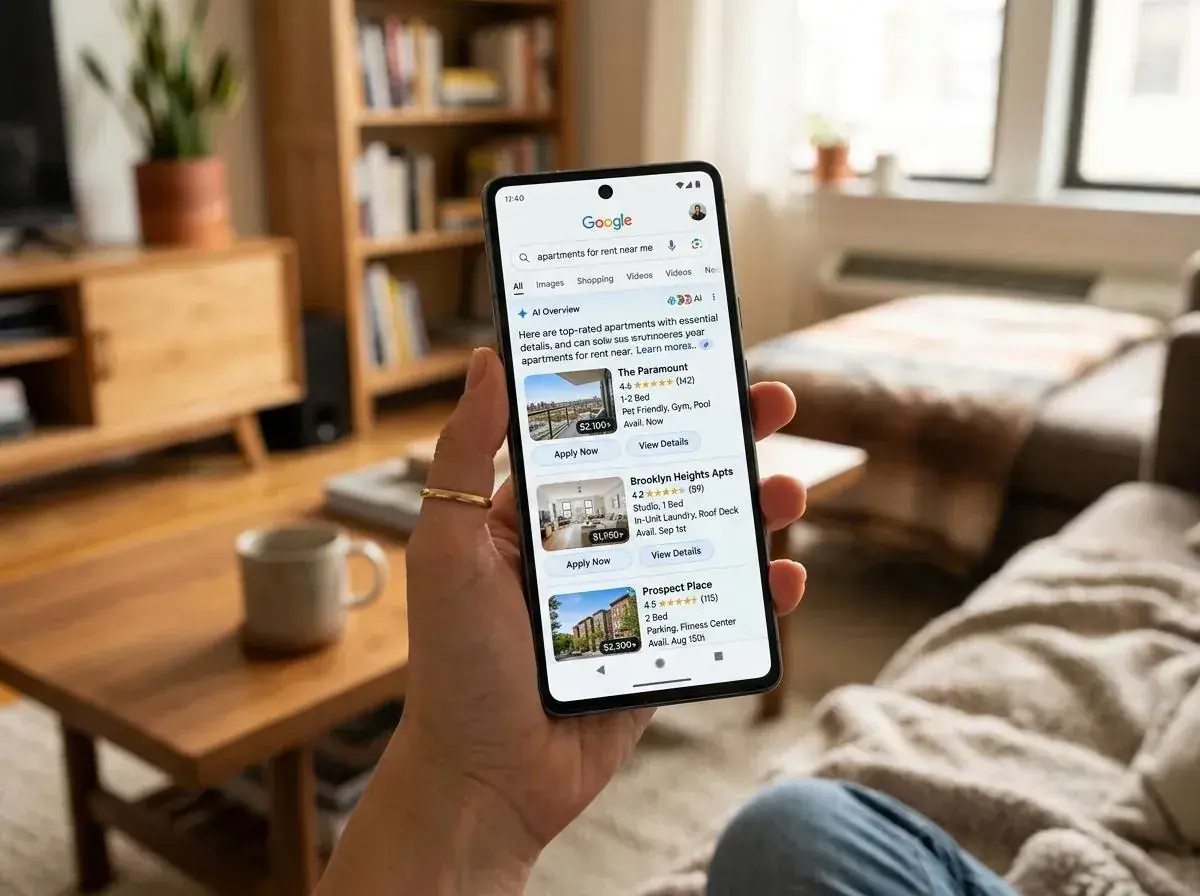
Every mobile session is worth more than it was two years ago
Apartment List's July 2026 report puts the national median rent at $1,388, the vacancy index at 7.2 percent, and the average unit taking 30 days to lease after listing. That is the longest July reading in its data going back to 2019, and the overall record was set in January of this year at 41 days. Units are sitting longer, so each inquiry is worth more and each abandoned mobile session costs more.
ShowMojo's numbers sharpen the point. Accurately priced units averaged 27 days on market while units that needed a price reduction averaged 60. Nobody wants to discover that a listing needed a price cut when the actual problem was that the gallery took eight seconds to appear on a phone. Before you touch the rent, check what the listing looks like on the device three quarters of your prospects are holding.
Seven steps to a genuinely mobile-first site
Open your own listings on a phone, on cellular
Not the office wifi and not the desktop responsive preview. Use a mid-range phone on a mobile connection, find a unit, and try to book a tour. Time it. Most teams have never done this once, and it takes ten minutes.
Put the photos first and make them fast
The first unit photo should be the first thing that renders, correctly sized for a phone rather than a desktop hero, with the rest lazy-loaded behind it. Half of renters treat missing unit photos as a deal-breaker and a gallery that has not appeared yet is functionally missing.
Answer the obvious questions without a scroll
Rent, availability date, bedrooms, bathrooms, pet policy and deposit belong in the first screen of the listing. A renter comparing ten properties does not scroll to find a price, they close the tab.
Make calling and booking one tap each
A tel: link and a self-scheduling button on every listing page, both reachable without opening a menu. With 61 percent of inquiries arriving after hours, self-scheduling is not a convenience feature, it is the difference between capturing the inquiry and losing it.
Cut the mobile inquiry form to four fields
Name, email, phone and the unit or move-in date. Set the input types and autocomplete attributes so the phone fills most of it automatically. Everything else is a question for the follow-up, not for the thumb typing at eleven at night.
Fix the tap targets and the thumb zone
Meet the WCAG 2.2 minimum of 24 by 24 CSS pixels as a floor, go larger on primary actions, and move the buttons that matter into the lower half of the screen where a one-handed grip can reach them.
Measure mobile separately
Split every conversion report by device. A blended conversion rate hides a mobile problem behind desktop performance, and mobile is where three quarters of your traffic and most of your after-hours demand actually lives.
The bottom line
Mobile-first is not a design style, it is an accurate description of who is on your website. 71 percent of renters search from a phone, Google has crawled every site with a smartphone crawler since July 2024, 61 percent of rental inquiries arrive after your office closes, and the average renter cuts ten properties down to three before anybody at your company hears from them. None of that is fixed by a responsive theme that technically reflows. It is fixed by the boring specifics: the first photo rendering immediately, the price visible without a scroll, a tap-to-call link, a booking button that works at ten at night, and a four-field form the phone can fill in itself. Open your own listing on your own phone tonight and try to book a tour. Whatever slows you down is slowing down every renter you paid to get there.